
Armenia's information war: Russia targets the June 7 vote
An AI-generated image shows Armenian Prime Minister Nikol Pashinyan marching in a Pride parade in Yerevan. The event never happened.

A Facebook account called “Sasha Simonyan” enthusiastically backs Pashinyan — its profile picture is that of an American actress. A leaked document reveals that a Kremlin-linked Russian marketing firm has been planning a diaspora media outlet to turn Armenians living in Russia against their own government. With six days to go before Armenia’s June 7, 2026 legislative elections, the country has become the target of an information war whose scale, according to researchers, surpasses anything seen in recent elections in Moldova or Georgia.
At a Glance
Russia’s Social Design Agency (SDA), sanctioned by the EU and the United Kingdom for disinformation operations targeting Ukraine, orchestrated coordinated influence campaigns against Pashinyan — including a false rumor that he had purchased a multimillion-euro villa in Marseille, southern France. The story accumulated over 10.6 million views.
The disinformation is not exclusively Russian in origin: Armenian opposition parties also deployed AI-generated fake street interviews on TikTok to attack one another.
The June 7 vote is a decisive test of Armenia’s strategic direction. The country initiated EU membership proceedings in April 2025, following its February 2024 suspension of participation in the Collective Security Treaty Organization (CSTO), Russia’s military alliance in the post-Soviet space.
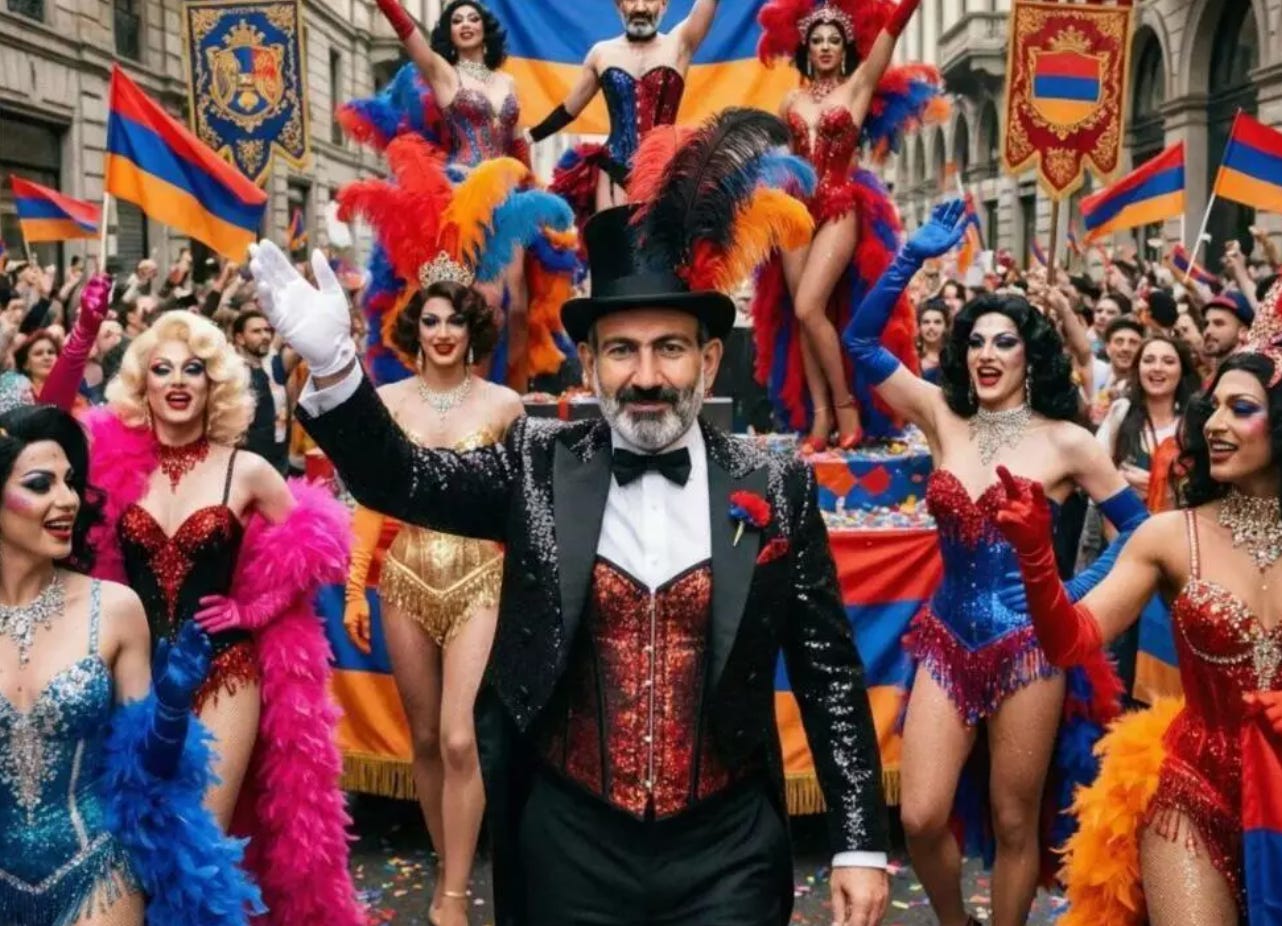
This image is used for illustrative purposes only. AI generated.
A disinformation machine with many faces
For months, researchers and Armenian civil society organizations have documented an unprecedented surge in electoral disinformation. At the center of the domestic operation is a site called MediaNews, which daily amplifies content from pro-Pashinyan social media accounts. An investigation by fact-checkers at CivilNet, an independent Armenian news outlet, established that most of those accounts are patently artificial — their profiles contain only AI-generated images or photos taken from real people found online. One fake profile, for example, uses a photo of American actress Sasha Alexander as its avatar.
The scale of foreign operations dwarfs the domestic picture. A document leak attributed to Russia’s Social Design Agency (SDA) — a digital marketing firm sanctioned by the European Union and the United Kingdom for running online manipulation campaigns against Ukraine — revealed a coordinated operation targeting Armenia. Among the documents reviewed by Reuters, one described plans to create a media outlet called “Yerevan1,” targeting the Armenian diaspora in Russia. Its stated purpose was to foster a “negative attitude” toward Pashinyan and spread the message that Armenia “can only prosper in close alliance with Russia and under its protection.”
The Marseille villa and the fake Pride: two defining examples
Among the most viral campaigns was a false claim that Pashinyan had purchased a luxury villa worth several million euros in Marseille, France. The prime minister made no such purchase. The story nonetheless spread across social networks, accumulating more than 10.6 million views.
The cultural register was also weaponized. AI-generated images circulated online depicting Pashinyan at a fabricated Pride event in Yerevan. Pink Armenia, an Armenian LGBTQ+ rights organization, was contacted directly by activists from other countries who had been approached by an unknown party asking them to produce content about the supposed Yerevan Pride. After verifying, the organization confirmed that no such event had taken place or was planned.
The operation known as “Matriochka,” identified by researchers at Euronews’s The Cube fact-checking unit, produced 343 doctored videos published in early May — making it one of the largest such operations in recent years. The campaign relies increasingly on artificial intelligence, including fake footage depicting Pashinyan and French President Emmanuel Macron concluding a supposed “secret deal”: French electoral support in exchange for Armenia triggering a military conflict against Russia after a Pashinyan victory.
Not only Moscow
If the scale of Russian operations is in a different league from domestic campaigns, Ani Grigoryan, a researcher at CivilNet, notes that disinformation does not flow in a single direction. Armenian opposition parties have themselves resorted to fake AI-generated vox-pop videos on TikTok to attack each other. Both the governing party and the opposition are, in turn, perpetrators and targets.
Philippe Kalfayan, a member of the executive council of the International Observatory for Peace (OIP), acknowledged that “disinformation exists on all sides” — while noting that its scale remains profoundly asymmetric.
Why Armenia became a priority target
The rupture between Yerevan and Moscow has a clear turning point: September 2023. Azerbaijan’s military takeover of Nagorno-Karabakh — a disputed enclave in the South Caucasus long home to an ethnic Armenian population — triggered a mass exodus despite the presence of Russian peacekeepers on the ground. Pashinyan publicly blamed Moscow for failing to protect Armenia. In February 2024, Armenia suspended its participation in the CSTO, Russia’s military alliance roughly equivalent to NATO for the post-Soviet space. In April 2025, the country formally launched EU membership proceedings — a dramatic westward turn.
For Moscow, a Pashinyan victory on June 7 risks cementing that geopolitical shift permanently. According to Western intelligence officials cited by Reuters, Russia has escalated covert interference operations beyond online disinformation, including reportedly organizing the transportation of dual-nationality Armenian voters from Russia to influence the outcome. This claim has not been confirmed by Armenian institutional sources.
Analysis: the Caucasian laboratory of information warfare
Armenia is not an isolated case. The documented playbook replicates, with local adaptations, the methods deployed during Moldovan and Georgian elections — fake news sites, spoofed logos of Western media outlets (CNN, Reuters and Bloomberg have all been imitated, according to CivilNet), AI-generated accounts, and deepfake videos.
What sets the Armenian case apart is its dual dimension. Armenia is simultaneously a major geopolitical target for Moscow — which seeks to prevent its exit from the Russian sphere of influence — and a country where domestic disinformation pre-existed foreign interference. That combination makes it particularly difficult for ordinary voters to distinguish between external manipulation and homegrown information disorder.
The results of June 7 will indicate whether mass digital influence operations, however sophisticated, can actually shift electoral behavior in a country where mistrust of Russia has hardened since 2023.
The Bottom Line
If Pashinyan wins despite the campaigns mounted against him, Armenia will become evidence that mass disinformation can be absorbed by a society that has already chosen its direction.
If it shapes the result, it will become the precedent that Eastern European emerging democracies most fear. Either way, the June 7 ballot will be studied as a live test of the limits of information warfare in the post-Soviet space.
Sources: France 24 · Euronews · Reuters