
Armenia 2026: A historic realignment is taking shape
Six days before the June 7 vote, polls give Pashinyan's party 65% among decided voters as Moscow uses trade bans and disinformation to block Armenia's pro-Western shift.

On June 7, Armenians are not simply electing a parliament. They are choosing between two geopolitical orbits — and according to the latest available polling, their answer looks unambiguous. The Civil Contract party of incumbent Prime Minister Nikol Pashinyan would capture nearly 65% of the vote among decided voters, leaving a fragmented, Russia-aligned opposition in the dust. If the numbers hold, the result would redraw the geopolitical map of the South Caucasus.
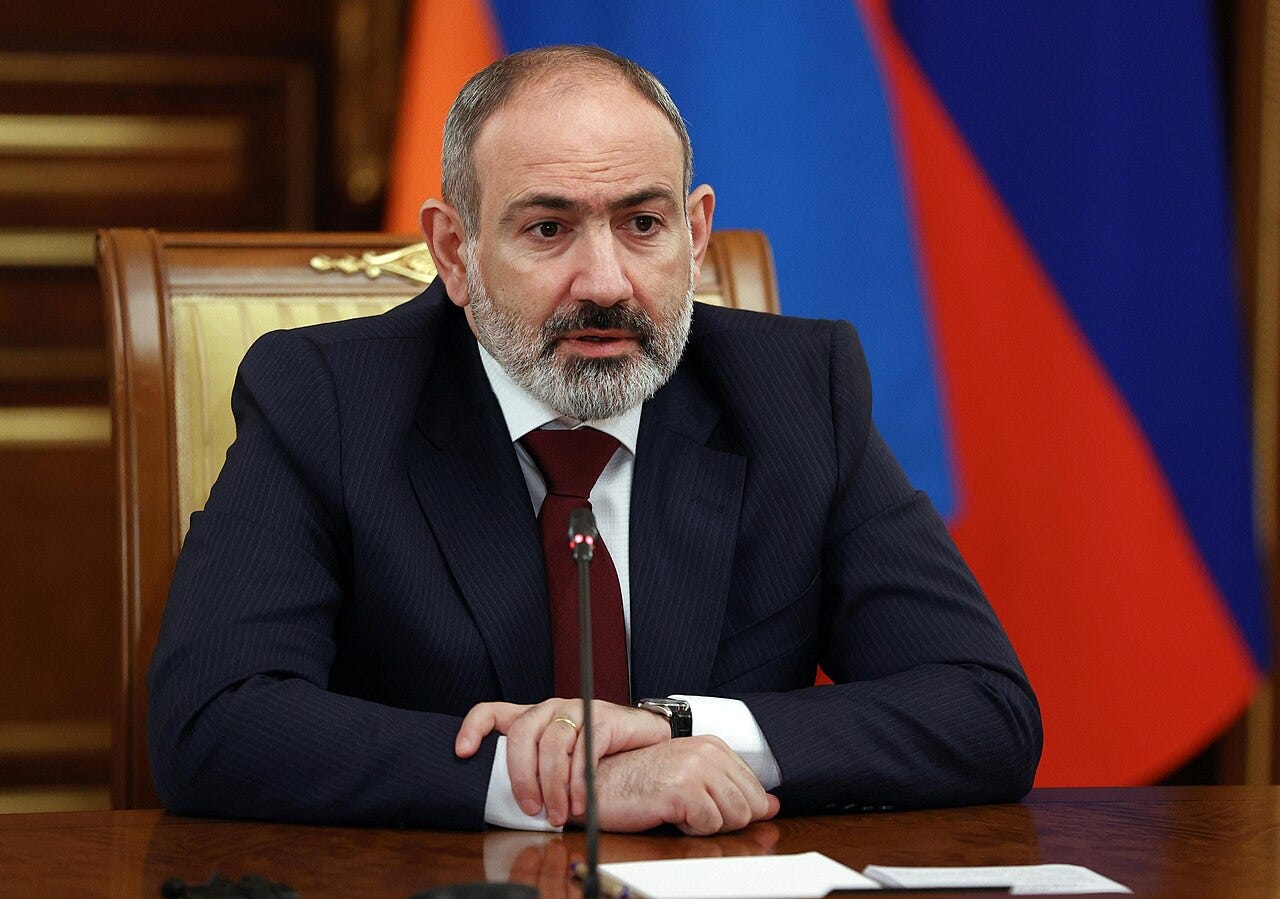
This image is used for illustrative purposes only.
At a Glance
A poll by the Breavis institute (May 5–11, 2026, 1,551 respondents) projects Civil Contract at nearly 65% among voters who have made up their minds — a separate survey by the International Republican Institute puts the party’s overall support, including undecided voters, at approximately 32%, still comfortably ahead of any rival.
No opposition party tops 12% in either survey. The closest challenger, Strong Armenia, a pro-Russian party backed by oligarch Samvel Karapetyan, trails far behind.
Russia has recalled its ambassador “for consultations,” imposed bans on Armenian mineral water, wines, brandy, and select produce, and threatened to cut discounted gas supplies — even as Armenia sources more than 80% of its gas from Russia.
U.S. President Donald Trump declared his “full and absolute support” for Pashinyan, while Western intelligence officials cited by Reuters signaled that Moscow was planning to bus tens of thousands of Armenian voters from Russia to sway the outcome.
Reading the polls — and their limits
Two surveys frame the pre-election landscape, and they tell a consistent but nuanced story. The Breavis institute poll, conducted May 5–11 among 1,551 respondents, projects Civil Contract at nearly 65% — but exclusively among voters who have already decided. Armenia’s electorate includes a significant share of undecided voters, and that distinction matters: the International Republican Institute (IRI), whose surveys are more widely cited in international coverage, places Civil Contract’s overall support at approximately 32% when the full electorate is measured.
Both figures point in the same direction — Civil Contract dominates — but the gap between them is a reminder that turnout dynamics and late-breaking decisions could affect the size, if not the direction, of Pashinyan’s likely victory. Whether that translates into a working majority, a strong majority, or something approaching a parliamentary supermajority will depend on how many opposition parties clear the electoral threshold and how fragmented the remaining vote proves to be.
A fragmented but persistent opposition
The opposition landscape is divided and, for now, outgunned. The most prominent challenger is Strong Armenia, a party backed by Samvel Karapetyan, one of Armenia’s wealthiest businessmen and a figure widely seen as aligned with Russian interests. In a political environment where the central fault line runs between pro-Western and pro-Russian orientations, Strong Armenia represents the clearest institutional expression of the Moscow-aligned camp — though it has struggled to consolidate the opposition vote behind a single banner.
Several other smaller parties are competing for the remaining electorate, none polling in double digits. The fragmentation of the pro-Russian opposition may, paradoxically, work against it: in a proportional system, parties that fail to cross the threshold lose their votes entirely, potentially inflating Civil Contract’s seat share beyond what raw polling numbers suggest.
The mechanics of a strategic break
Armenia’s westward realignment did not happen overnight. It reflects a longer sequence, accelerated by two defining events: the catastrophic loss of Nagorno-Karabakh in 2020 — a conflict widely perceived within Armenia as evidence of Russian abandonment — and the signing of a landmark peace agreement with Azerbaijan in August 2025 at the White House, with Donald Trump serving as host, which ended decades of armed conflict between the two neighboring countries.
This sequence illustrates a broader pattern: several small states in the former Soviet space have been reassessing the real cost of their alliance with Moscow in the wake of Russia’s full-scale invasion of Ukraine in 2022. For Armenia, that reassessment has been blunt. With more than 80% of its gas supplied by Russia, the country retains a critical structural vulnerability even as its political leadership accelerates toward the West.
Russia’s escalating toolkit
Moscow did not wait for election results to signal its displeasure. Its response has been multidimensional. On the diplomatic front, Russia recalled its ambassador “for consultations” — the standard formulation for signaling serious displeasure without formally severing ties — after Yerevan officially filed for closer ties with the European Union. On the economic front, a series of targeted bans has hit Armenian export products: mineral water, wines, brandy, and then select fruits and vegetables. The threat of suspending discounted gas deliveries looms in the background.
The leaders of the five member states of the Eurasian Economic Union (EAEU) — a Moscow-led trade bloc comprising Russia, Belarus, Kazakhstan, Kyrgyzstan, and Armenia, functioning as an integrated market and free-trade zone roughly analogous to a Russia-controlled version of the EU’s single market — convened at a summit in Astana, Kazakhstan, and issued a joint declaration warning that Armenia’s EU membership bid poses “serious risks” to the bloc’s economic security. They called on Yerevan to hold a national referendum on the choice between Brussels and Moscow — a demand Pashinyan has so far ignored.
Vladimir Putin also drew an explicit parallel between Armenia and Ukraine, stating before assembled press at the Astana summit that “the crisis in Ukraine began, at one point, with Ukraine’s attempts to join the EU.” Whether this constitutes deliberate intimidation or a sincere strategic warning remains a matter of interpretation — the intent cannot be formally established from public statements alone.
Disinformation and diaspora mobilization
Russia’s pressure campaign extends beyond economic and diplomatic tools. According to Western intelligence officials cited by Reuters, Moscow was reportedly planning to organize the transport of tens of thousands of Armenian voters from Russia — citizens of the Armenian diaspora residing there — to influence the vote. If confirmed, this would represent a direct form of electoral interference, distinct from the more conventional disinformation campaigns Armenian authorities say they have also documented.
Armenia, with approximately 3 million people within its borders, has a substantial diaspora community in Russia. The mobilization of that diaspora could, according to these sources, meaningfully affect a proportional vote where every percentage point matters for smaller parties fighting to survive the parliamentary threshold.
The U.S. factor in the Caucasus equation
Trump’s declared support for Pashinyan — describing him as a “great friend and great leader” who is making Armenia “strong, prosperous, and very safe” — has altered the geopolitical calculus. It signals that Washington views Armenia as a strategically significant theater in the South Caucasus, at the intersection of Russian, Turkish, and Iranian interests.
This stance represents a notable shift in tone from previous years, during which the U.S. had maintained a degree of equidistance in Caucasus affairs. It could indicate a more active American strategy to extend Western influence into post-Soviet spaces previously considered durably within Moscow’s near abroad — though the depth of that strategic commitment remains to be demonstrated beyond electoral endorsements.
The real question is not whether Pashinyan will win — it is whether a strong mandate can actually insulate Armenia from an energy and economic dependency on Russia that the best political intentions alone cannot dissolve in a matter of months.
Sources: Euronews · Reuters · International Republican Institute