
Antisemitism in Bavaria: a hotel turns away Jewish guests — and justice takes notice
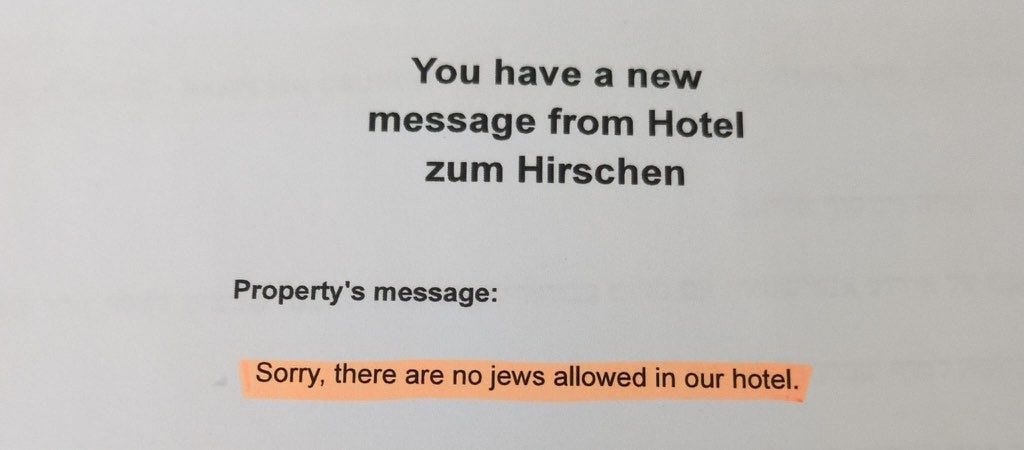
A Bavarian hotel allegedly refused to accommodate an Israeli family on the grounds that they were Jewish.

The incident, amplified by Israel’s consul general in Munich, has reached the halls of Bavaria’s Justice Ministry — and lands against the backdrop of record antisemitic offenses in Germany.
At a Glance
The Hotel zum Hirschen in Lam, Bavaria, allegedly rejected a booking from an Israeli family, citing a policy of excluding Jewish guests; Booking.com has removed the property from its platform.
The case has been referred to Bavaria’s Justice Ministry for review of a potential hate incitement charge under Section 130 of Germany’s Criminal Code.
Antisemitic offenses in Germany hit a record high in 2024, with 6,236 incidents recorded — including 173 violent acts — a trend that has accelerated since the Hamas attack on Israel on October 7, 2023, and the broader regional conflict now involving the United States, Israel, and Iran.
This image is used for illustrative purposes only.
A refusal that shocked — and a story that divides
In early June 2026, an Israeli family attempted to book a room at the Hotel zum Hirschen in Lam, a small town in Bavaria, southern Germany. According to a screenshot circulating on social media, the response they received was unambiguous: the property would not host Jewish guests.
Talya Lador, Israel’s consul general for southern Germany, reacted immediately on X: she questioned whether Europe was returning to the 1930s and praised Booking.com for swiftly removing the hotel from its listings.
Guy Katz, a Munich-based professor who also spoke out publicly, called the response antisemitic — not the product of workplace stress. In a LinkedIn post written the day after the incident, he argued that no amount of professional pressure can produce that kind of language unless the sentiment already existed.
“Not in 1938, not somewhere on the internet — but in Bavaria, yesterday.”
[Translated from German; source: LinkedIn post by Guy Katz, published the day following the incident]
The hotel initially denied the allegations before acknowledging that an employee was responsible for sending the message. A letter of apology was sent both to the family involved and to Bavaria’s State Chancellery (Staatskanzlei, the office of the state premier). The hotel also offered the Israeli family a complimentary week-long stay.
A competing account has also emerged, and it deserves serious consideration. Its author, who claims to have spoken directly with the owners, says the Hotel zum Hirschen — run by the same family for 120 years — has been overwhelmed by fraudulent bookings in recent months. Because the Israeli family’s reservation was the first received from a country outside the European Union, staff reportedly suspected another fraud attempt and responded accordingly. This explanation has not been independently verified, but it has not been dismissed either — and it is part of why German authorities are examining the case rather than treating it as clear-cut.
The legal machinery behind the case
The case has been referred to Bavaria’s Justice Ministry, where it is being examined with the involvement of the state’s antisemitism commissioner (Antisemitismusbeauftragter). The charge under consideration is hate incitement under Section 130 of Germany’s Criminal Code (Volksverhetzung) — a provision that criminalizes speech or conduct inciting hatred against segments of the population. No formal proceedings have been opened as of this writing.
The legal framework is not abstract. In Flensburg, a city in northern Germany near the Danish border, a shopkeeper who had posted a sign reading “Jews are forbidden to enter” was recently convicted of hate incitement. The sentence: six months in prison, suspended, and a €1,200 fine payable to the KZ-Gedenkstätte Ladelund, a memorial to a Nazi-era forced labor camp in the Nordfriesland district. The court found that his act was “of a nature to disturb public peace” — a formulation that now frames the Bavarian case as well.
A pattern, not an outlier
The incident in Lam does not emerge from a vacuum. In 2024, antisemitic offenses in Germany hit a historic high: Germany’s Federal Criminal Police Office (Bundeskriminalamt, roughly equivalent to the FBI) recorded 6,236 incidents — a category that spans violent attacks but also encompasses propaganda, harassment, and verbal abuse. Among those, 173 involved actual violence. In the first half of 2025 alone, authorities had already logged 2,044 antisemitic offenses, including 50 violent incidents. Full-year figures for 2025 are not yet available.
These numbers track a trajectory that began after the Hamas attack on Israel on October 7, 2023, and has continued to climb since the outbreak of the wider regional conflict involving the United States, Israel, and Iran. A January 2026 study by the Central Council of Jews in Germany (Zentralrat der Juden in Deutschland), the umbrella body representing Germany’s Jewish communities, put the shift in stark terms: 62% of Jewish communities surveyed said their security situation had further deteriorated since the Iran conflict began. The Council’s president, Josef Schuster, described what has followed the post-October 7 surge as a “new normal.”
That framing — normalization rather than escalation — may be the most significant signal. What once registered as a shock is increasingly becoming background noise.
Analysis: when ordinary spaces become hostile ground
What is happening in Bavaria is not, at its core, a hospitality dispute. It is the visible expression of hostility that may have long existed but is now surfacing — sometimes without shame — in ordinary, everyday settings: a shop window, a professional email inbox, a booking response.
Germany’s institutional machinery has responded: the justice system has been engaged, Booking.com acted quickly, and a dedicated antisemitism commissioner is involved. But these structural responses leave unanswered a harder question: how does an ordinary person, in the course of a routine commercial transaction, arrive at sending that message?
The “fraud” explanation offered by the hotel is not simply a deflection — it represents a genuinely unresolved dimension of this case. It may be true, partially true, or false. Courts will weigh it. What it cannot do is erase the symbolic weight of the incident for the family involved or for Germany’s Jewish community. A family that receives that message, whatever the sender’s intent, experiences it as a statement about who belongs and who does not.
Germany has some of Europe’s most stringent laws against racial and antisemitic hatred, a direct inheritance of the Holocaust written into its Basic Law and criminal code. But legal tools cannot fully contain what appears to be a deeper cultural shift: the gradual desensitization to antisemitic language, amplified by social media and fueled by ongoing geopolitical tensions. The Lam case is a data point in a larger pattern that is worth watching carefully — not just in Bavaria.
The Bottom Line
The case at the Hotel zum Hirschen may be resolved within weeks — either dropped or prosecuted. But the question it raises will outlast its verdict: in a country that has made Holocaust remembrance a foundational commitment, how far can law and institutions go to address what is shifting in people’s minds? And what do these incidents, multiplying in a Europe simultaneously at war, under political stress, and navigating an unresolved identity crisis, reveal about the durability of the postwar democratic compact?
Sources: Euronews · Bundeskriminalamt · Zentralrat der Juden in Deutschland