
Andy Burnham: the "King of the North" takes on Starmer
Andy Burnham, Manchester's mayor for nine years, is running to lead the Labour Party — and potentially to become Britain's next prime minister.

His record in Manchester is both his strongest asset and his most closely scrutinized credential.
Andy Burnham, Mayor of Greater Manchester since 2017, confirmed on the BBC on June 4, 2026, that he will challenge Keir Starmer for the leadership of the British Labour Party — provided he wins the Makerfield by-election scheduled for June 18. The only senior politician in Britain maintaining a positive net favorability rating among the general public, he forces a question that is reshaping British politics: can you govern the United Kingdom from Manchester?
At a Glance
Andy Burnham, 56, three-time Mayor of Greater Manchester — a region of 2.8 million people — officially announced his leadership bid on June 4, 2026, conditional on winning the Makerfield by-election and returning to Parliament.
The only senior politician in Britain with a positive favorability rating among the general public, according to YouGov polling from May 2026, he leads all potential Labour leadership candidates by a wide margin among party members.
His record in Manchester — the Bee Network public transit system, a significant drop in rough sleeping since 2017, a £2.6 billion ($3.3 billion) consolidated regional budget covering transport, waste, police and mayoral functions across all 10 councils — is both his electoral calling card and the model he intends to scale nationally.
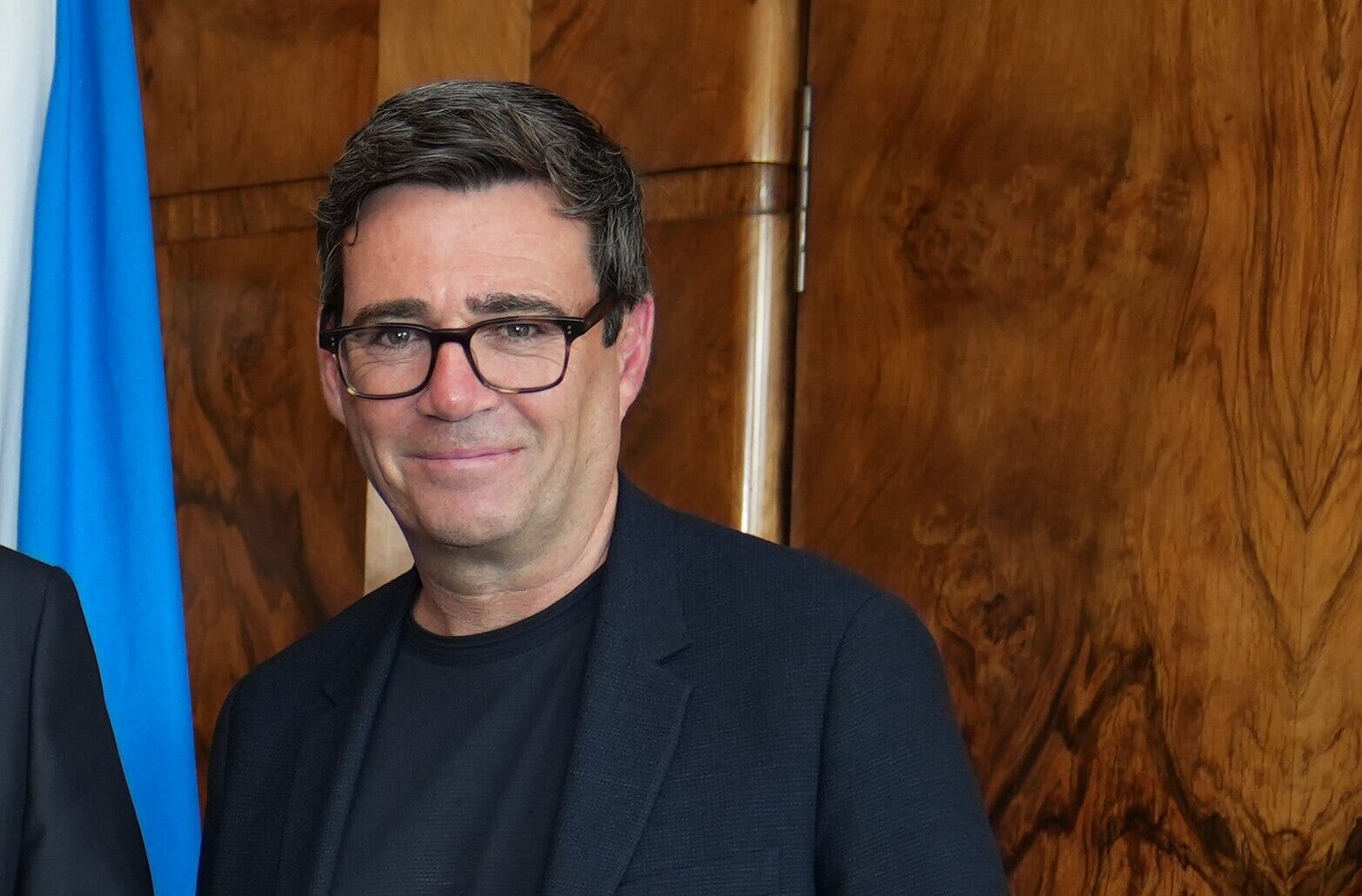
This image is used for illustrative purposes only.
A path back to Westminster, engineered for the occasion
The Makerfield by-election, in the Greater Manchester area, is no accident of timing. On May 14, 2026, Josh Simons, the sitting MP for the constituency and a former ally of Starmer, resigned his seat explicitly to give Burnham a route back into Parliament. It is the first time since the 1965 Leyton by-election that a parliamentary resignation has been openly orchestrated to hand a seat to a prospective party leader.
The constraint is institutional: Labour Party rules require any candidate for the leadership to be a sitting member of Parliament. Burnham, as Mayor of Greater Manchester, is prohibited by law from simultaneously holding a seat in the House of Commons — the UK’s elected lower chamber, equivalent to the U.S. House of Representatives. Should he win Makerfield on June 18, the mayoralty would become vacant immediately.
Polling places him ahead, though not comfortably. An initial Survation survey conducted May 18–22 put him at 43% against 40% for Reform UK’s Robert Kenyon, a local plumber and city councillor. A second poll (May 26–June 1, N=518) extended his lead to 49% against 39%. The constituency has been continuously Labour-held since 1983 — but Reform UK swept seven of eight wards in the Wigan council elections in May 2026, signaling a genuinely competitive contest.
The Manchester record: real, but contested
Nine years into his tenure leading the Greater Manchester Combined Authority (GMCA) — a regional body that brings together 10 local councils under a single elected mayor, roughly analogous to a U.S. metropolitan regional authority — Burnham has accumulated a track record that even opponents acknowledge.
Transit. The Bee Network — a system of buses and trams brought under public control — is the centerpiece of his mayoralty. Rolled out between September 2023 and January 2025, it made Greater Manchester the first area outside London to bring its entire bus network back under public management since deregulation under Margaret Thatcher in the 1980s. In the earliest franchised zones, annual ridership grew 14% year-on-year, while network-wide bus journeys rose 5% over the first full year of operation — a meaningful reversal of decades-long national decline. Left-wing critics have noted, however, that the model remains franchise-based: private operators continue to run the routes while fares and schedules are set publicly. The ownership structure, they argue, preserves private profit within a publicly funded framework.
Rough sleeping. Burnham’s flagship homelessness policy is Housing First — providing rough sleepers with permanent housing immediately, with wraparound social support, rather than making housing conditional on sobriety or compliance with other criteria. Since the pilot launched in 2019, more than 450 people have been housed, with an 88% tenancy retention rate. Rough sleeping across the region has fallen by between 50% and 57% since 2017 — depending on the annual snapshot — bucking the national trend. The Social Market Foundation, an independent UK think tank, has validated the approach, noting that program costs are offset by savings to health services, criminal justice, and emergency shelters.
Structural limits. The GMCA’s £2.6 billion consolidated budget — drawn from transport levies, waste services, policing precepts and central government grants — remains heavily dependent on allocations from Whitehall, a constraint Burnham himself acknowledges. In February 2026, he announced free transit passes for 8,000 homeless children in temporary accommodation, a meaningful measure that also highlighted the persistence of deep poverty across the region.
The politics: why Starmer can no longer ignore him
Burnham’s appeal extends well beyond the Labour base. YouGov’s April 2026 favorability tracker credited him with a net positive rating of +9 among the British public as a whole — the only politician in the country in that position. By May 2026, following Labour’s disastrous local election results, his score had settled at +4, still uniquely positive: Starmer stood at −46, Chancellor Rachel Reeves at −49.
Among Labour Party members, the picture is starker. A YouGov poll of 706 members published in May 2026 found that 47% ranked Burnham as their first choice for leader, compared to 31% for Starmer. In a direct head-to-head, 59% of members would choose Burnham over the current prime minister. Crucially, 74% of members believe Labour would likely win the 2029 general election under Burnham’s leadership, against just 28% who think the same under Starmer.
That calculus has made Burnham impossible to sideline. Starmer had previously attempted to block him from an earlier by-election in January 2026: Labour’s National Executive Committee — the party’s governing body — voted 8-to-1 against allowing Burnham to stand in Gorton and Denton. The move drew accusations of political maneuvering from dozens of Labour MPs and was widely seen as having accelerated the erosion of Starmer’s authority within the party.
“Manchesterism” as a national proposition
What Burnham is offering is less an ideological break than a methodological one. His approach — sometimes described as “Manchesterism” — rests on devolving power to regional cities, integrating public services at the local level (transit, housing, health), and a “forgotten North” rhetoric that resonates with voters Labour has been bleeding to Reform UK.
Burnham speaks to the same constituencies without promising the same disruptions.
The proposition could represent a credible response to Nigel Farage’s Reform UK party, which has been capturing voters in post-industrial northern towns by offering simple answers to complex problems. His positioning — pragmatic and center-left, uncomfortable to place on Labour’s traditional left-right spectrum — is part of his political strength.
Yet scaling up raises genuine questions. Manchester’s achievements rest partly on Burnham’s personal political capital and on a relatively coherent metropolitan region. Whether a model built for 2.8 million people translates to governing 67 million remains an open and unresolved question — one his opponents have begun pressing with increasing urgency.
The Bottom Line
The Makerfield by-election on June 18, 2026, is not a local race. It is a live test of whether British Labour can renew itself from the margins — from the North, from city halls, from policy grounded in results rather than Westminster ideology. If Burnham wins and launches a leadership contest, the real question will not be whether he can defeat Starmer. It will be whether “Manchesterism” can survive contact with national power — and whether a country in economic and political crisis is prepared to bet on a man whose defining achievement is having put yellow buses back on the streets of Bolton.
Sources: BBC · AP News · Al Jazeera · YouGov · Survation · Greater Manchester Combined Authority · House of Commons Library