
Amazon bets $11 billion on Europe

The e-commerce and logistics giant is pouring more than €10 billion into modernizing its European warehouse network, adding 25,000 jobs and rolling out AI-guided robots — all while the EU struggles to keep its own tech champions from leaving.
At a Glance
Amazon announced an investment of more than €10 billion ($11 billion) in its European logistics network, including warehouse automation powered by robots — among them an upgraded version of its autonomous robot Proteus, designed to understand employee instructions in natural language.
The company plans to add 25,000 jobs across its European distribution centers and is committing $1 billion to employee training in Europe through 2030, as part of a global $2.5 billion workforce development program.
The announcement comes as European policymakers debate how to stop the continent’s best companies from heading to the U.S.: according to a landmark report by Mario Draghi, former president of the European Central Bank (ECB), nearly 30% of European-born unicorn startups founded between 2008 and 2021 eventually relocated their headquarters abroad — most of them to the United States.
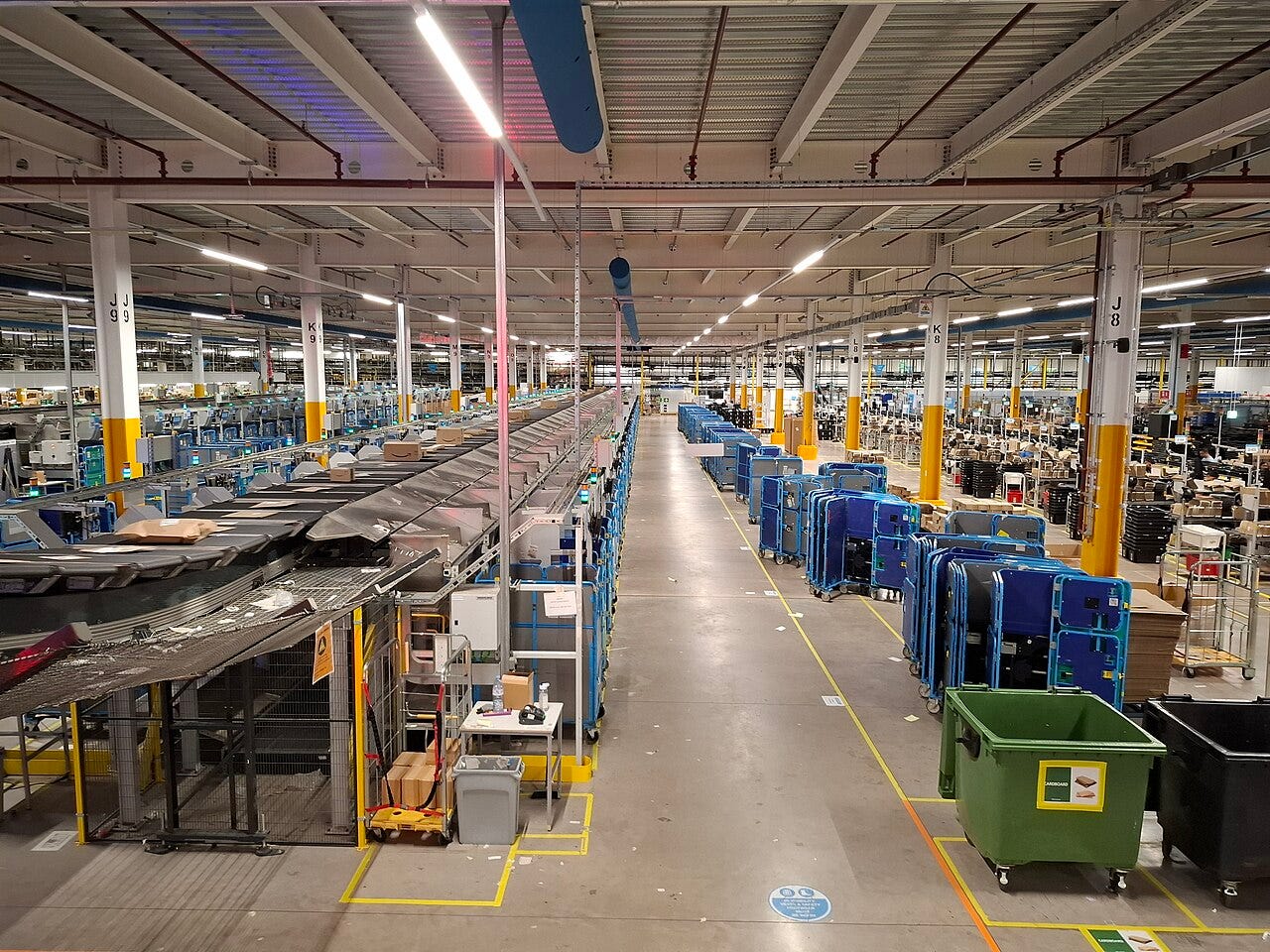
This image is used for illustrative purposes only.
An American giant doubles down on Europe
More than €10 billion. That is Amazon’s headline commitment for its European logistics network, announced Thursday at the company’s “Delivering the Future” event in London. The multi-year plan covers the expansion and modernization of Amazon’s warehousing and delivery infrastructure across a network that already spans the U.K., Germany, France, Italy, Spain, Poland, the Czech Republic, and Slovakia.
The figure builds on an already striking baseline: Amazon says it invested more than €60 billion in Europe in 2025, its largest annual investment on the continent to date. The momentum, in other words, is not new — it is accelerating.
Robots that take orders in plain English
A substantial portion of the €10 billion will go toward robotics and automation across Amazon’s distribution centers — the large fulfillment hubs where orders are sorted, packed, and shipped. The company frames the shift in worker-friendly terms: automated systems would handle the most physically demanding tasks, such as moving heavy loads or performing repetitive lifting, freeing human employees for other roles on-site.
Among the technologies unveiled is an upgraded version of Proteus, Amazon’s autonomous warehouse robot. According to the company, this new iteration will be able to understand employee instructions in natural language — making the interface between worker and machine more intuitive than ever in a warehouse environment.
The question Amazon’s framing sidesteps remains open: does automation ultimately create as many jobs as it displaces, or does it simply shift work toward a smaller, more skilled workforce?
25,000 jobs and a billion dollars for training
Amazon says the investments will support the creation of 25,000 additional jobs across its European distribution centers over the coming years. The company already claims to support more than 1.5 million jobs across the continent: 230,000 direct Amazon employees, more than 400,000 workers in its extended workforce (contractors, seasonal staff), and more than 600,000 jobs tied to the roughly 200,000 small businesses and entrepreneurs selling through its marketplace.
Alongside the infrastructure spending, Amazon will dedicate $1 billion (approximately €860 million at current exchange rates) to training its European workforce through 2030, as part of a broader global program totaling $2.5 billion. Target areas include cybersecurity, software development, logistics, renewable energy, and mechatronics — all sectors where European labor markets face chronic shortages.
Europe’s tech sovereignty problem, in the background
Amazon’s announcement lands against a backdrop that goes well beyond logistics. Europe is in the middle of a serious reckoning with its ability to grow and retain its own technology champions in competition with American and Chinese giants.
A report by Mario Draghi — former president of the European Central Bank (ECB) and former Italian prime minister — highlighted that nearly 30% of unicorn companies born out of European startups founded between 2008 and 2021 later relocated their headquarters abroad, mostly to the United States. This phenomenon, sometimes called entrepreneurial brain drain, has become a driving concern among EU policymakers.
In response, proposals such as EU Inc. — which would allow startups to register once and operate seamlessly across all EU member states, similar to how a U.S. company can incorporate in Delaware and operate nationally — are under active discussion in Brussels. The goal is to reduce the regulatory fragmentation that makes it harder for European companies to scale at the speed their American and Chinese competitors can.
Analysis — When Amazon builds what Europe can’t
There is a certain irony in the picture. While Europe debates how to keep its companies and talent at home, it is an American corporation that is investing billions in European infrastructure and European jobs.
This is not philanthropy. Amazon invests where its markets are profitable, where demand for fast delivery is sustained, and where logistics costs can be optimized through automation. The 25,000 jobs are real — but they serve a coherent industrial logic, not a sense of continental solidarity.
What is more revealing is the nature of those jobs. The positions announced are largely execution-focused roles in distribution centers — precisely the kind of work that automation is designed, over time, to reduce or transform. The billion-dollar training commitment suggests Amazon is already planning for that transition: it would rather upskill its own workforce than absorb the social costs of abrupt layoffs.
The real question for European policymakers is not whether Amazon is good or bad for employment. It is why American capital — and not European capital — is funding the modernization of the continent’s logistics backbone. And whether initiatives like EU Inc. or broader structural reforms can reverse that dynamic before Europe is permanently cast as a deployment market, rather than an innovation hub.
Amazon invests in Europe because Europe is profitable for Amazon. The European Union is still searching for the tools that would make Europe profitable for Europeans.
The Bottom Line
Between those two dynamics — the efficiency of a private actor and the institutional slowness of a continent still integrating — the global technology race is not waiting.
Sources: Euronews · Draghi Report (European Commission)