
Albania: when a Trump deal triggers a democratic crisis
Jared Kushner's luxury resort plan on Albania's protected coastline has ignited historic protests in Tirana — exposing a deeper crisis of democratic governance.

Thousands of Albanians have taken to the streets of Tirana for three consecutive nights. The trigger: a multibillion-euro tourism project backed by Jared Kushner, son-in-law of U.S. President Donald Trump, and Ivanka Trump, on Sazan island — a former Soviet military base off Albania’s southern coast. The flamingo, an endangered species threatened by the development, has become the symbol of a protest movement that reaches far beyond environmental concerns.
At a Glance
In December 2024, Albania’s government granted strategic investor status to Atlantic Incubation Partners LLC, a company linked to Kushner’s Affinity Partners investment fund, bypassing competitive bidding for a luxury resort on Sazan island (approximately €1.4 billion) and a hotel complex at Zvernec, part of a larger coastal development valued at several billion euros.
Legislative amendments adopted in late 2024 stripped protected status from coastal areas including the Vjosa-Narta wetlands, enabling contracts to be signed without public tender — Albania’s Special Anti-Corruption Prosecutor’s Office (SPAK) has opened an investigation.
The “Flamingo Revolution,” as it has been dubbed on social media, demands both the cancellation of the project and the resignation of Prime Minister Edi Rama — a dual rejection experts describe as unprecedented since the fall of Albania’s communist regime.
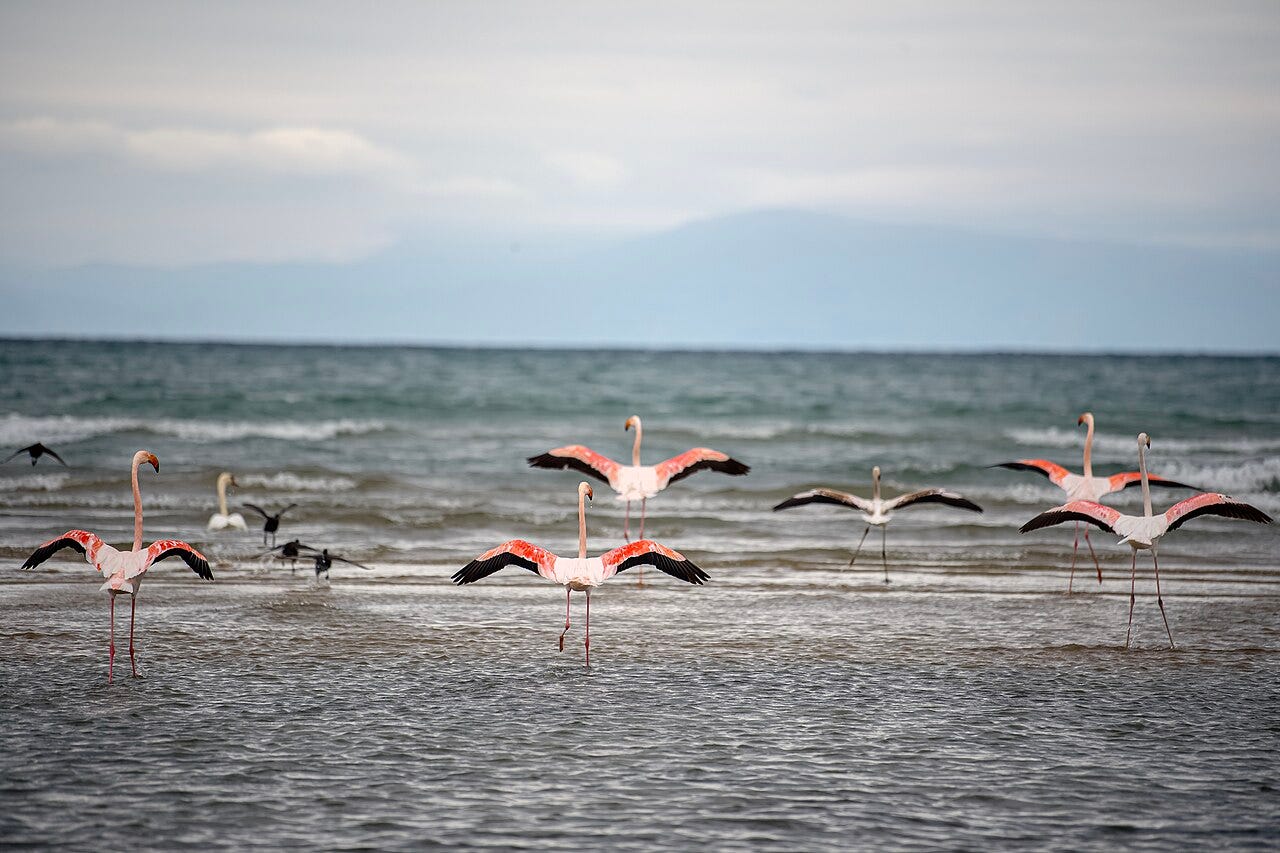
This image is used for illustrative purposes only.
An opaque deal, an island for sale
Sazan is no ordinary piece of land. Its 5.7 square kilometers at the junction of the Adriatic and Ionian seas host one of Europe’s last wetlands of its kind, including a population of more than 200 flamingos. The island also carries Cold War history: a former Soviet military outpost, it had until now escaped the wave of tourist investment that transformed Albania’s coastline.
In December 2024, the government of Edi Rama — Albania’s prime minister since 2013, whose ruling Socialist Party has steadily consolidated its grip over the country’s institutions — granted strategic investor status to Atlantic Incubation Partners LLC, a company linked to Affinity Partners, Kushner’s private investment fund. The designation grants access to accelerated administrative procedures and the coordinated support of multiple ministries, without competitive bidding. Alongside this, legislative changes quietly stripped the Vjosa-Narta coastal area of its protected status, enabling contracts to be signed without public tender.
The two projects are at different stages. For Sazan island, the prime minister’s office has stated that no definitive agreement has been signed, and that the Albanian state would remain a stakeholder and direct beneficiary of any eventual development. The Zvernec complex is more advanced: preliminary works were already underway by early 2026, when Ivanka Trump visited the site with a group of architects and investors in January. Affinity Partners, when contacted, referred inquiries to a communications firm, which issued a statement attributable to “Asher Abehsera, president of Sazan Real Estate Development LLC“ — a company that had no verifiable legal registration at the time of publication.
How a construction site became a political crisis
What ignited the street protests was not a planning document. It was footage: bulldozers on the beach, barbed wire blocking access to the shoreline, private security guards physically confronting local residents who had gathered to protest in late May 2026. The videos spread rapidly on Instagram, transforming diffuse public irritation into mass mobilization in the capital.
For three successive evenings, thousands of Albanians gathered in Tirana. SPAK, Albania’s Special Anti-Corruption Prosecutor’s Office — an independent body established to investigate high-level corruption — opened an investigation into the modification of the Vjosa-Narta protected zone’s legal status, the contracts awarded without competitive tender, and the origin of the funds involved. The property rights dimension further complicates the picture: like much of Albania’s land, the area is subject to disputed ownership claims dating back to the communist dictatorship of Enver Hoxha, who abolished private property in 1945. Dozens of families still claim rights over portions of the land transferred under the project.
This is not the first time Albanian public assets have been subject to non-transparent arrangements. What is different this time is the international visibility of the partner — and the bluntness of the process. As Gëzim Alpion, a Birmingham-based sociologist of Albanian origin, has argued, there is a longstanding pattern among Albanian leaders of sacrificing pieces of national territory to consolidate power — an observation that may explain why this particular deal struck such a deep nerve.
Beyond the flamingos: a crisis of legitimacy
The “Flamingo Revolution” label is memorable — and misleading. It reduces to an environmental controversy what several Albanian political scientists describe as a fundamental breakdown of trust between citizens and their government.
The protest movement is notably hybrid in composition, according to Klevis Kolasi, an Albania specialist at Ankara University: it spans a broad cross-section of civil society and demands not only the cancellation of the project but the departure of both Prime Minister Rama and his main political rival, Sali Berisha, leader of the opposition Democratic Party. That double rejection is significant: the protesters are not seeking a change of government — they are rejecting the political system as a whole.
Since 2013, Rama has steadily extended his government’s grip over most of Albania’s institutional checks and balances. His response to the protests — publicly stating the project would continue for as long as he remained in office — may prove a strategic miscalculation. By positioning himself in direct confrontation with the street, he risks transforming a governance crisis into a regime crisis.
“When Albanians get angry, it can turn very violent.” — Julian Myftari, political scientist, University of Tirana
The 1997 precedent is not merely a historical footnote. That year, the collapse of a network of Ponzi schemes that had absorbed the savings of thousands of families triggered widespread violence — sometimes described as a near civil war — which ultimately required international intervention.
The international dimension: more than a real estate deal
For a non-European reader, the temptation might be to file this story under “Trump family business interests abroad” and move on. That would miss the point.
Albania is a candidate for membership in the European Union, roughly analogous to a country applying for admission to a major economic and political bloc with strict rule-of-law requirements. To advance in that process, Tirana must demonstrate measurable progress on judicial independence, anti-corruption enforcement, and public procurement transparency. The Sazan-Zvernec affair is a concrete test case: a government that grants strategic investor status to a company linked to a U.S. president’s son-in-law, amends its legislation accordingly, and responds to public criticism with private security forces sends a troubling signal to the European Commission — the EU’s executive arm, which monitors candidate countries’ progress — and to the European Parliament, the EU’s directly elected legislative body, which must ultimately approve any accession.
It is plausible that Brussels is watching this sequence with particular attention — not out of sympathy for the protesters, but because it illustrates precisely the governance challenges that EU accession chapters on rule of law are designed to address.
The Bottom Line
If SPAK’s investigation runs its course and legislative irregularities are confirmed, Edi Rama will face a choice that few Balkan leaders have managed well: retreat on a project backed by Washington and risk losing face to the street, or hold course and potentially compromise Albania’s European trajectory. The question is no longer whether flamingos will survive on Sazan — it is whether Albania can build a functioning rule-of-law state while its land remains negotiable.
Sources: France 24 · AFP · TV5 Monde