
Albania rises up over Trump ties and Rama's rule
For weeks, Albanians have been flooding Tirana's streets to protest a luxury resort linked to Jared Kushner and Ivanka Trump — and a government accused of rewriting the law to make it happen.

At a Glance
Protesters have gathered nightly in Tirana since late May, with the movement reaching its peak on June 10–11, when tens of thousands took to the streets in the largest demonstrations yet against a luxury resort project linked to Jared Kushner and Ivanka Trump planned inside a protected coastal zone.
The movement has rapidly expanded beyond environmental concerns to challenge the entire political class — and above all Prime Minister Edi Rama, who has governed Albania since 2013, accused of amending environmental protection law to enable the project and of lacking transparency over permits and corporate structures.
The European Union has warned Tirana that the project could jeopardize Albania’s EU membership bid, turning a domestic crisis into a geopolitical test.
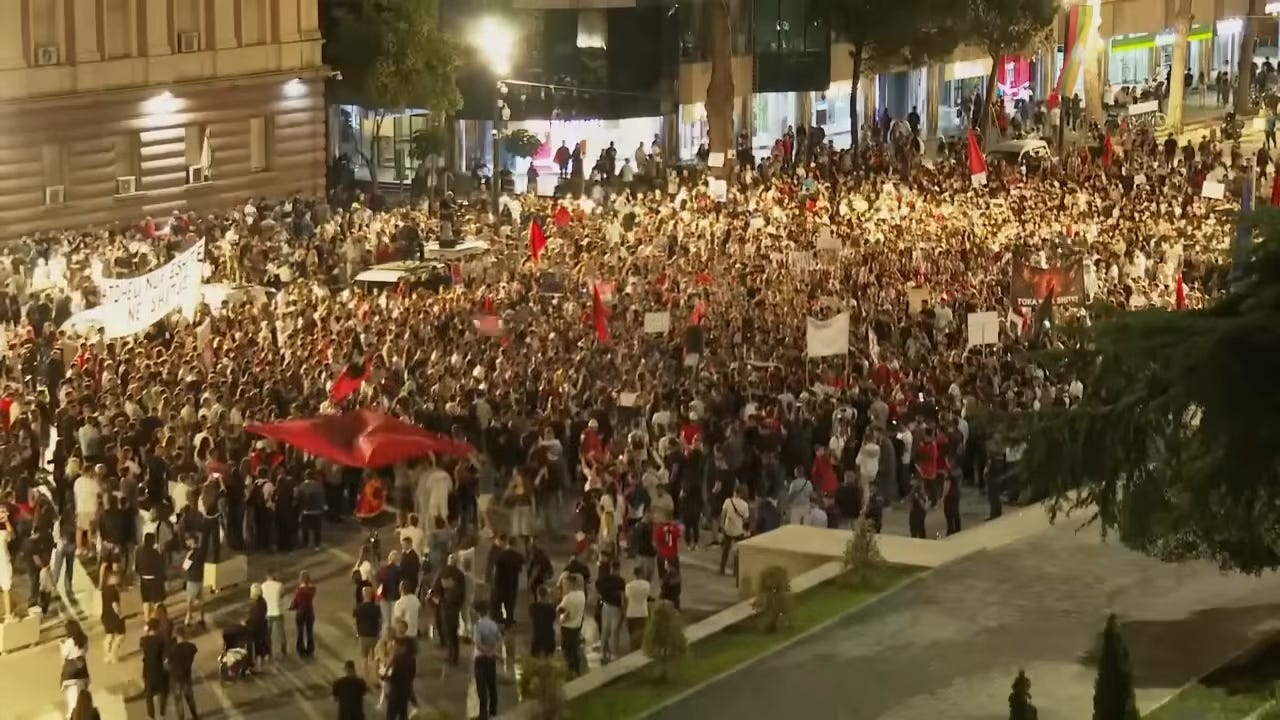
This image is used for illustrative purposes only.
The flamingo vs. the concrete
In the Vjosa-Narta lagoon, along Albania’s southwestern coast, thousands of flamingos, Dalmatian pelicans, and sea turtles inhabit one of the last unspoiled coastal ecosystems in the Balkans. Those species — symbols of a natural heritage the Albanian state appeared ready to sacrifice — have given their name to one of the most significant protest movements the country has seen in decades.
The trigger: a luxury hotel and resort complex linked to Jared Kushner, son-in-law of President Donald Trump, and Ivanka Trump, slated for construction inside this officially protected zone. The project, with an estimated value of around €1.4 billion, gained traction after Albania’s government amended its protected areas legislation in 2024 to allow this type of commercial development — a move critics called tailor-made for the deal. Anti-corruption investigators and civil society groups have since raised concerns about the transparency of permits and the corporate structures involved.
Edi Rama’s government has backed the project throughout. The prime minister — in power since 2013, a celebrated architect turned statesman long presented as the reformist face of post-communist Albania — has stated his intention to see the investment through, despite mounting pressure from protesters and European institutions.
Demonstrations began in late May and have grown steadily, with thousands gathering in the capital on most evenings. On Thursday, June 11, the movement reached a new peak, with tens of thousands of Albanians in the streets — the largest protest yet — demanding the prime minister’s resignation directly beneath his windows.
When ecology becomes politics
What began as an environmental protest has transformed, within weeks, into a political movement of unprecedented scale. On Tirana’s streets, demonstrators accused Rama of having sold Albanian land to foreign investors, arguing that his refusal to acknowledge popular opposition left resignation as the only acceptable demand.
A young woman named Xhesika carried a cardboard flamingo — now the unmistakable symbol of a movement that targets not just the real estate project, but an entire governing class perceived as corrupt and out of touch. Protesters made clear they were not only demonstrating against the prime minister, but against all those who have governed Albania over the past three decades — a rebuke that pointedly includes the opposition as well.
A generation that once voted with its feet — by leaving — is now voting with its presence, in the streets, night after night.
This convergence is not accidental. It may signal a structural breakdown of trust between Albanian society and its political elites — a fracture the Kushner project may have exposed but did not create.
Generation Z: staying to fight
Albania is one of Europe’s most affected countries when it comes to youth emigration. For decades, a significant share of its population — particularly young graduates — has left for Italy, Greece, Germany, or the United Kingdom. That demographic hemorrhage is itself a symptom of deep political disenchantment.
It is precisely this generation that is now on the front lines. Alvin, 25, captured the shift: where fear and resignation had long defined his peers’ response to injustice, he said the moment had arrived when staying silent was no longer an option — and for the first time in a long time, he felt genuine hope that things could change.
Albania’s Generation Z appears to be making an unprecedented choice: resisting rather than leaving. If sustained, this dynamic could represent a political inflection point in a country where emigration has long been the default response to state corruption.
The European stakes: Tirana under Brussels’ watch
The crisis carries additional weight given Albania’s particular position on the European stage. A candidate for membership in the European Union since 2014, Albania is held to strict standards on rule of law, anti-corruption measures, and environmental protection — the very areas at the heart of this dispute.
Brussels has already signaled its concern: a luxury development inside a protected natural zone, enabled by retroactive changes to environmental law and surrounded by unanswered questions about permitting and corporate transparency, could undermine Albania’s EU accession trajectory. That warning, rare in its directness, transforms what might have remained a domestic dispute into a test of Albania’s European credibility. A candidate country cannot, under the watchful eye of EU institutions, authorize the destruction of a protected natural zone for the benefit of investors linked to a sitting foreign head of state.
Rama, for his part, has shown no sign of backing down — though the project has faced procedural pauses for review. His resistance to popular pressure and EU warnings could reflect economic calculations — Albania remains one of the continent’s poorest countries — or political ones. But it is plausible that this unyielding posture is deepening his isolation, both domestically and with his EU partners.
The bottom line
A wetland, a flock of flamingos, and a resort bearing the Kushner name: on the surface, this is a local story. In reality, it poses a question that many Southeastern European countries will have to answer in the years ahead — how far can a government go to attract foreign capital before it sacrifices its territory, its legal framework, and its European credibility? Albania is formulating an answer in the streets. The real question is whether Edi Rama will hear it before Brussels forces the issue.
Sources: France Info · AFP