
Abramovitch, the unlikely peacemaker
Zelensky is betting on a Kremlin-friendly oligarch to force Putin to the negotiating table — and sending a message to the world.

At a Glance
Ukrainian President Volodymyr Zelensky has tasked Roman Abramovitch, a Russian billionaire under EU sanctions since 2022, with relaying to Vladimir Putin his offer of a direct meeting — with no preconditions on format or timing.
Abramovitch is no newcomer to shadow diplomacy: he was present at the first Russia-Ukraine peace talks in Turkey in late March 2022, has since facilitated multiple prisoner exchanges, and played a role in the 2022 Black Sea Grain Initiative.
The move carries an obvious communications dimension: by publicly naming a Russia-friendly intermediary, Zelensky positions himself as the side making every effort — against a Putin who continues to refuse any direct meeting.
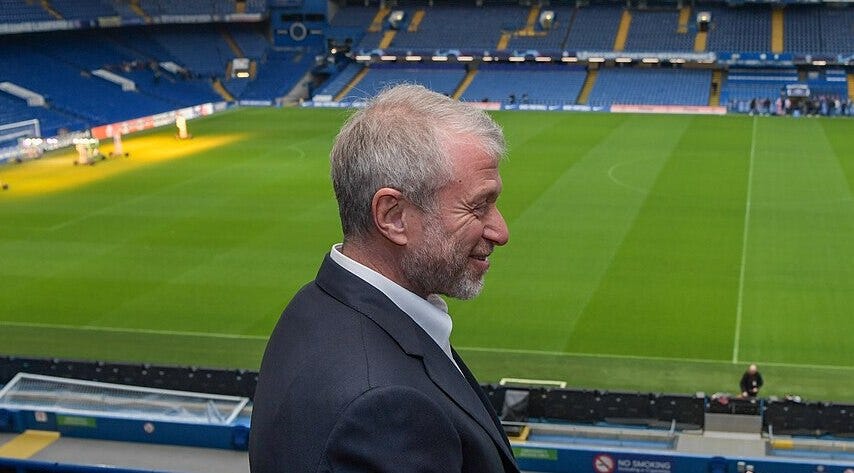
This image is used for illustrative purposes only.
A billionaire between two warring capitals
Roman Abramovitch met Volodymyr Zelensky in Kyiv in May 2026 — a meeting that reflected the dual nature of the channel itself. Abramovitch came to relay that the Kremlin was trying to understand what Ukraine truly wanted; Zelensky, in turn, asked him to carry a message back to Vladimir Putin: an offer of a direct meeting, in any format, at any time.
An unusual figure in the Russian oligarchic landscape, Abramovitch built his fortune close to the inner circle of Boris Yeltsin, the president who oversaw Russia’s chaotic transition to capitalism in the 1990s, before becoming the owner of the English Premier League club Chelsea — which he was forced to sell in 2022 under the pressure of European sanctions. Since then, he has lived between Turkey and the Gulf states, equidistant from both warring capitals but reachable by both sides.
His singular position rests on a rare combination: an unwavering loyalty to the Kremlin — he governed the Chukotka Autonomous Okrug, a remote region in Russia’s Far East, between 2000 and 2008 at Vladimir Putin’s request, and has never publicly criticized Russia’s war against Ukraine — paired with a deeply Westernized image, cultivated in part through the Garage Museum of Contemporary Art in Moscow, founded in 2008 by his former wife Dasha Zhukova, whose name is also associated with the board of the prestigious Met Gala in New York.
Shadow diplomacy: a long-established specialty
This go-between role is not improvised. Abramovitch was already present at the first Russia-Ukraine peace negotiations in Turkey in late March 2022, where he was presented as a facilitator between the two delegations. He also reportedly contributed to the 2022 Black Sea Grain Initiative, which allowed Ukraine to resume its cereal exports. More recently, he has intervened on several occasions to help broker prisoner exchanges between the two sides, and reportedly attempted — without success — to secure the release of Alexei Navalny, the Russian opposition leader who died in a Russian penal colony in February 2024, in exchange for the return of Russian detainees.
This operational discretion is partly explained by his legal and geographic situation: excluded from both Russia and the United Kingdom by sanctions, he operates in the margins of formal diplomacy, where his connections to both parties are precisely what gives him value.
Moscow has not denied the existence of such contacts. Putin acknowledged having met with a representative of the Russian business community, without confirming the intermediary’s identity. Abramovitch himself declined to comment.
The political calculus behind the choice
The decision to use Abramovitch reveals several simultaneous tensions. First, the absence of any official diplomatic channel between Kyiv and Moscow more than four years after the start of Russia’s full-scale invasion. Second, the need for Zelensky to find an interlocutor who is both audible in the Kremlin and credible in the West — a combination that is exceedingly rare. The content of Zelensky’s message, as he described it, left little room for ambiguity on the core issue: no territorial concessions in the Donbas. The offer was one of direct dialogue, not of compromise on the ground.
According to experts, Abramovitch’s real influence over Putin’s decisions would nonetheless remain limited. Having the Russian president’s ear is not the same as persuading him to make territorial concessions: the oligarch may be able to open a door, but not force it. The military situation on the ground is likely the determining factor in Russia’s negotiating posture — far more so than signals sent through discreet intermediaries.
The communications dimension of the announcement should not be underestimated. By publicly revealing the name of his envoy, Zelensky sends a signal to the international community: he is willing to go as far as relying on a Putin-aligned oligarch to open a direct dialogue. This posture stands in stark contrast to the other intermediary recently put forward on the Russian side: Gerhard Schröder, the former German chancellor whose well-documented pro-Russian sympathies make his international credibility considerably more fragile.
The bottom line
Zelensky’s bet is legible: use the informal networks of Russian capitalism where official diplomacy has failed. But the real question raised by this choice is not whether Abramovitch can persuade Putin — there is little reason to believe he can. It is whether, in the event of a future agreement, Western democracies will be comfortable with the idea that part of its architecture will have rested on oligarchs operating entirely outside any institutional framework.
Peace, if it comes, will say something about the means the world is willing to accept to reach it.
Sources: France 24 · The Guardian