
A Russian disinformation suspect inside the EU Parliament
An organization accused of pro-Russian disinformation held a conference inside the EU Parliament. The real story isn't the group — it's the loophole.

At a Glance
On February 24, 2026, the AllatRa Global Research Center co-organized a conference on nanoplastics at the European Parliament in Brussels, alongside Czech far-right MEP Ondřej Knotek.
Ukraine’s security services accuse AllatRa of justifying Russian aggression and promoting a Kremlin-backed “Union of Slavic Peoples”; its founder, Igor Danilov, faces criminal charges for high treason.
An internal parliamentary inquiry found no “conclusive and unequivocal” evidence of wrongdoing — because AllatRa appears on the EU Transparency Register, that alone was enough to close the investigation.
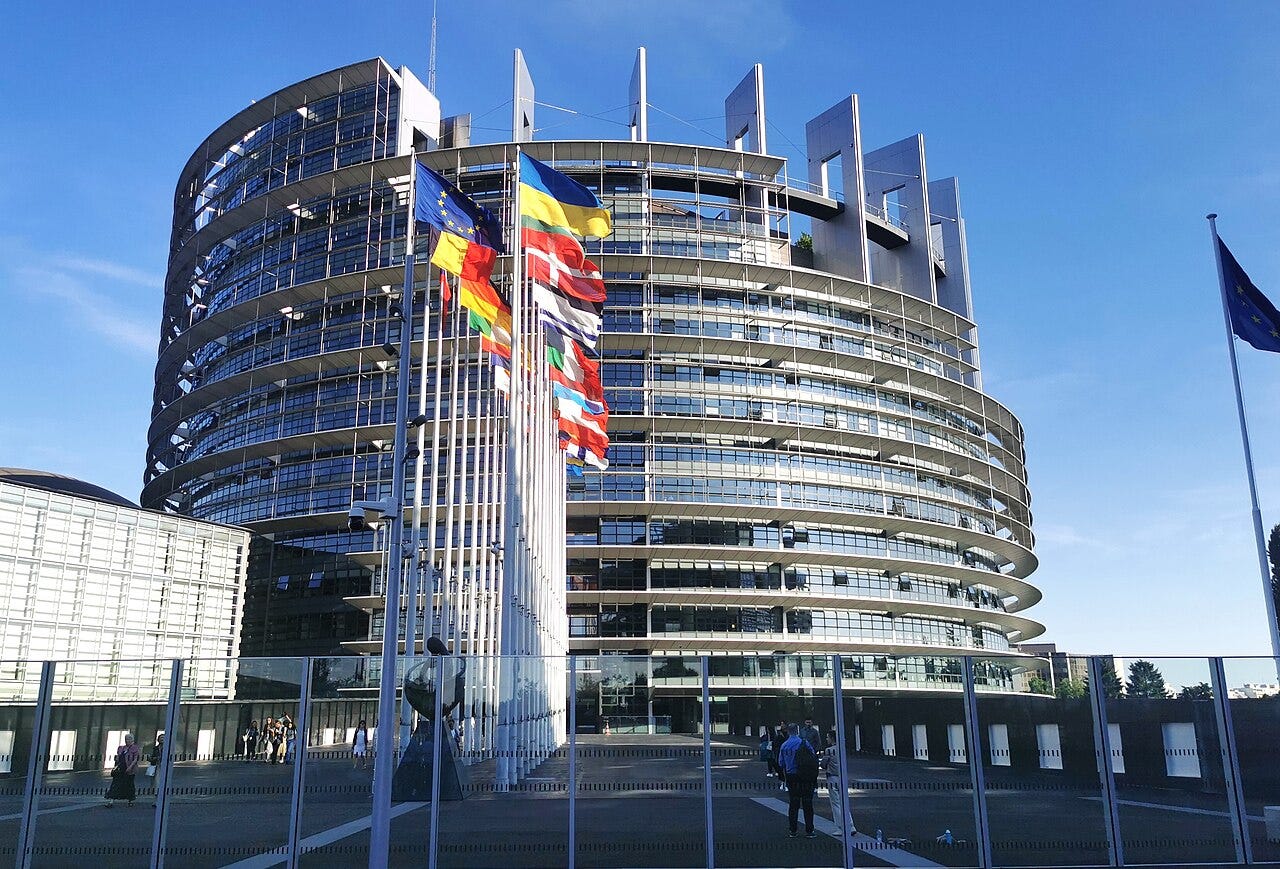
This image is used for illustrative purposes only.
How a plastics conference opened the doors of the European Parliament
On February 24, 2026, the European Parliament — the EU’s directly elected legislative body — hosted a scientific conference on the human and environmental risks of nanoplastics. On its face, unremarkable. The event was co-organized by the AllatRa Global Research Center and hosted by Ondřej Knotek, a Czech MEP from the Patriots for Europe group, a far-right bloc within the Parliament.
Several lawmakers pushed back hard. Danuše Nerudová and Jan Farský, both Czech members of the European People’s Party (EPP, the Parliament’s main center-right grouping, roughly equivalent to a moderate conservative coalition), and Slovak MEP Martin Hojsík of the liberal Renew Europe group, formally flagged the event. In the minutes of an internal parliamentary administrative meeting, they warned that AllatRa spreads “pro-Russian narratives” and maintains links with disinformation ecosystems associated with Russia — ties they argued were compromising the Parliament’s credibility.
Who AllatRa is — and what it denies
AllatRa presents itself as “an international think tank and research group addressing critical planetary challenges.” Founded in Ukraine and now based in the United States, the organization has drawn sustained scrutiny. Ukraine’s Security Service (SBU) — the country’s main domestic intelligence agency — accuses it of two specific offenses: justifying “the armed aggression of the Russian Federation” and promoting the Kremlin’s project of building a “Union of Slavic Peoples” under Moscow’s leadership.
AllatRa’s founder, Igor Danilov, is the subject of a Ukrainian police investigation on charges of high treason, participation in a criminal organization, and threats to national security. Czech media, notably the investigative outlet Seznam Zprávy, have tracked his profile for years. The organization is also reported to have roots in a religious movement and to circulate climate-skeptic and extraterrestrial conspiracy theories.
AllatRa has contested these characterizations on multiple fronts. In a statement targeting Seznam Zprávy — which had described the Parliament event as a gathering between a “pro-Russian sect” and MEP Knotek — the organization denounced what it called the spreading of false information damaging to its reputation. In a separate document dated November 6, 2025, AllatRa explicitly condemned “the armed aggression of the Russian Federation against Ukraine.” [translated from Czech/Ukrainian originals]
The institutional blind spot: is the lobbying registry enough?
This is where the real issue lies. AllatRa is registered on the EU Transparency Register — the official database that tracks organizations engaged in lobbying activities with EU institutions, roughly analogous to the foreign agent registration systems used by the U.S. Department of Justice and other governments. Ondřej Knotek cited this registration as proof of AllatRa’s legitimacy.
The parliamentary committee responsible for administrative and financial matters concluded there were no “conclusive and unequivocal elements” supporting the allegations. No deeper investigation was launched.
That outcome may signal a structural vulnerability in the Parliament’s screening mechanisms. EU Transparency Register listing is a prerequisite for accessing Parliament buildings — but it is not, and was never designed to be, an endorsement of an organization’s character or intentions. The registry documents presence; it does not certify integrity. This conflation of administrative accreditation with institutional validation is precisely the kind of opening that foreign influence operations are designed to exploit.
What this case reveals beyond AllatRa
The AllatRa episode fits a wider pattern. Since 2022, the European Union has significantly strengthened its counter-disinformation and foreign interference architecture — including the European Media Freedom Act and the East StratCom Task Force, a unit within the EU’s diplomatic service dedicated to identifying Kremlin-linked influence operations. These tools are primarily designed to target online information flows and clearly identifiable state actors.
What this case exposes is a gray zone: organizations that operate within the legitimate frameworks of civil society, academic research, or think tank activity — and that can access institutions through entirely legal channels. An MEP who invites such an organization breaks no rule. That is precisely the problem.
The European Parliament was not caught violating a procedure. It was caught exercising poor judgment.
For American readers familiar with debates over the Foreign Agents Registration Act (FARA), the parallel is instructive: registration does not protect against influence — it makes it visible. The EU Transparency Register serves a similar purpose, with similar limits.
The Bottom Line
The European Parliament did not walk into an obvious trap. It slid into a well-worn gray zone: organizations that know exactly how to clear administrative thresholds without crossing any legal line. The open question is not whether AllatRa is what Ukrainian authorities say it is — available evidence does not allow a definitive answer. The real question is this: was the EU Transparency Register ever designed to serve as the sole filter between a Parliament conference room and the rest of the world? And if the answer is no, who is responsible for the next layer of scrutiny — and by what criteria?
Sources: L’Express · Politico