
A goods-only deal: London pushes Brussels, Brussels pushes back
London proposed a single market for goods with the EU. Brussels said no. The episode reveals the structural trap of a Brexit neither side can fully escape.

At a Glance:
The British government recently proposed creating a dedicated single market for goods between the United Kingdom and the European Union — a move swiftly rebuffed by European officials, who countered with options London cannot politically accept
Brussels suggested either a customs union or realignment through the European Economic Area — both incompatible with Prime Minister Keir Starmer’s red lines ruling out free movement of people and loss of independent trade policy
Researchers estimate that Brexit has reduced U.K. GDP per capita by 6 to 8 percent compared to what it would have been had the country remained in the EU
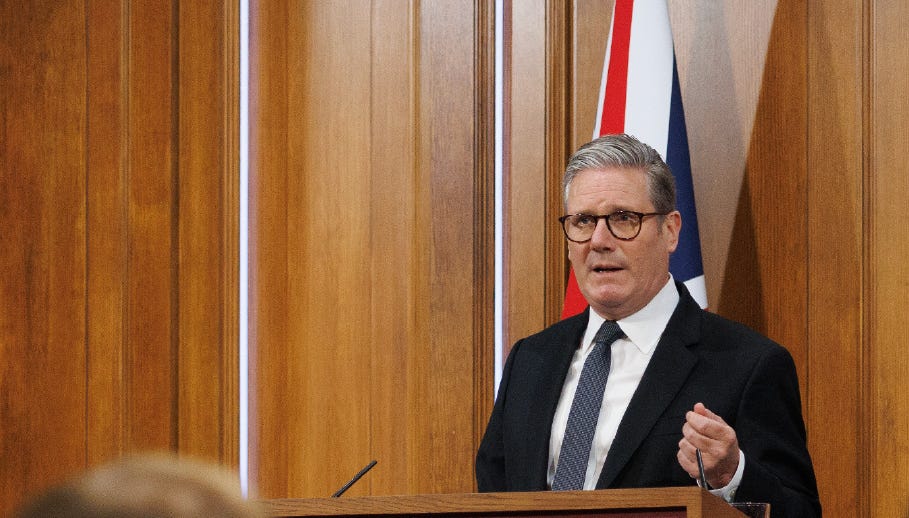
This image is used for illustrative purposes only.
The proposal that rattled Brussels
The idea was bold — perhaps too bold. The British government recently transmitted to Brussels, through Michael Ellam, the Cabinet Office’s top official on EU relations and London’s chief negotiator on European affairs, a proposal to establish a dedicated free-trade zone for goods between the United Kingdom and the European Union — without extending that alignment to services or the free movement of people.
The stated goal was to reduce trade friction and deepen economic integration with the continent, an objective Chancellor Rachel Reeves — the UK’s finance minister — has described as a strategic imperative for strengthening British economic resilience. Brussels’ response was swift: several EU member states, briefed on the initiative, relayed their reservations to the European Commission, which rejected the proposal as presented.
British government sources, however, pushed back on the narrative of a clean rejection, insisting the idea had not been definitively ruled out and remained on the table as one of several options ahead of a summit provisionally set for July 13. One European official offered a similar note of caution, saying member states had asked the Commission not to close the door and described the British thinking as genuinely ambitious.
To understand why the proposal stalled, it helps to grasp what the European single market actually is — something closer in spirit to what Americans know through NAFTA/CUSMA, where the free flow of goods comes bundled with shared rules and dispute mechanisms, except that the EU version rests on four indivisible freedoms: goods, services, capital, and people. Brussels has consistently refused to unbundle them. That is precisely what London is trying to do.
What Brussels is really afraid of
European resistance to this proposal is not purely a matter of legal principle. It follows an internal political logic of its own.
A deal too favorable to the United Kingdom — one that allowed London to access the benefits of the EU’s single market for goods while sidestepping its obligations (free movement, budget contributions, oversight by the EU’s top court, the Court of Justice of the European Union) — would be immediately weaponized by eurosceptic parties across the continent. With France’s presidential election approaching in 2027, and several movements hostile to European integration already positioning to capitalize on any perception of preferential treatment for a former member, the Commission cannot afford to set that kind of precedent.
The European counter-proposals — a customs union or alignment through the European Economic Area (EEA), the single market that includes non-EU members such as Norway, Iceland, and Liechtenstein — illustrate this delicate balancing act. A customs union would align the U.K. with the EU’s common external tariffs, stripping London of its ability to negotiate independent trade agreements — which is precisely what it has been doing, including a deal signed with the United States in May 2025. The EEA option would require accepting free movement of people, the most politically explosive issue for a Labour government already under pressure from the populist right.
The economy is forcing the issue
This diplomatic back-and-forth does not unfold in a vacuum. It plays out against an economic reckoning with Brexit that is becoming harder to ignore.
Researchers at Stanford University, King’s College London, and the University of Nottingham estimated in work published in early 2026 that Brexit had reduced U.K. GDP per capita by 6 to 8 percent by 2025, compared to a scenario in which the country had remained in the EU. Business investment was hit even harder, with an estimated contraction of 12 to 18 percent relative to that same benchmark. These figures are contested at the margins, but their order of magnitude now commands broad consensus in serious economic research.
It is against this backdrop that questions about Brexit are resurfacing openly in British public debate. Wes Streeting — a former Health Secretary who resigned from the government on May 14 to challenge Prime Minister Starmer’s leadership, and is widely seen as a frontrunner to replace him — described leaving the EU as a catastrophic mistake. A YouGov poll published in April 2026 found that 55 percent of British respondents now say they would support rejoining the EU — a decade after the 2016 referendum, in which the Leave campaign won 51.9% of the vote.
Starmer is navigating a knife’s edge. During his 2024 election campaign, he pledged that the United Kingdom would not rejoin the EU, the single market, or a customs union in his lifetime. That formulation, now repeated as a fixed mantra, leaves little room to pursue the level of integration the economy appears to demand.
Analysis: the post-Brexit circle that won’t square
The goods market proposal reveals a tension the Labour government has not resolved — and may be structurally unable to resolve. London wants the economic benefits of closer integration without accepting its institutional conditions. That is exactly what the 2016 referendum theorized — a tight commercial relationship without the supranational constraints — and exactly what the EU rejected from the first negotiations onward.
This asymmetry did not begin with Starmer. Theresa May advanced a similar idea in 2018 — the so-called Chequers Plan, which proposed aligning the U.K. on goods standards while diverging on services — and Brussels reportedly rejected it on the grounds that it amounted to cherry-picking the advantages of the single market while avoiding its obligations. What is new is that the demand now comes from a Labour government, one that framed Brexit as a Conservative error and now finds itself managing the same structural contradictions. Whether Starmer remains in office long enough to see those negotiations through is, as of this writing, an open question: over 95 Labour MPs have called for his resignation following the party’s worst local election results in decades, and a leadership contest may be imminent.
The stakes for Brussels are not trivial either. The EU needs a stable British partner on defense and energy. It has an interest in a financially healthy United Kingdom, if only to sustain the collective rearmament effort in response to Russia’s ongoing war in Ukraine. But it cannot offer an arrangement that would undermine the appeal of full EU membership for its current members or accession candidates.
The summit provisionally scheduled for July 13 will be the next inflection point. Sector-by-sector deals on veterinary products, carbon quotas, and youth mobility remain on the agenda — real but modest gains relative to the original ambition. The real question is not whether London and Brussels will reach some kind of agreement this summer: they probably will, partial and technical. The real question is whether those marginal compromises are enough to offset the structural cost of a departure the British economy is still absorbing — and that public opinion is beginning to reassess.
The bottom line
The United Kingdom wants deeper economic integration without accepting the institutional constraints that come with it — two goals that the EU’s architecture does not allow to be separated.
As long as that paradox remains unresolved in London, Brussels is in the comfortable position of the party that waits. The July summit will show whether that calculus still holds.
Sources: UK in a Changing Europe · City A.M. · Robert Schuman Foundation · National Bureau of Economic Research (NBER) · Council of the European Union